

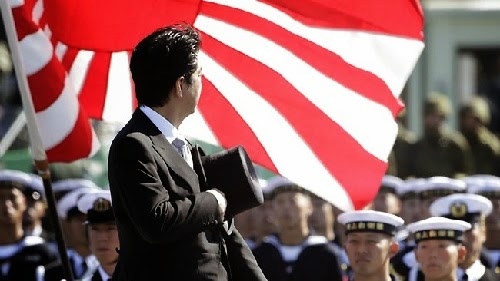
In recent
years Japan has been stepping up its efforts to break out of two
decades of economic and political stagnation characterized by
negligible growth, deflation, and successive short-lived governments.
With the election of Shinzo Abe in 2012 the government has made a
determined effort to reform the Japanese economy, as well as shift
the nation’s political culture. Whereas Japan has maintained a
pacifist outlook since WWII, in recent years the conservative
government has sought to chart a more assertive course. Japan has
increased it’s defense spending and procurement, and the government
has made it clear it wishes to review Article Nine, the pacifist
clause in Japan’s post-war constitution. Abe’s efforts to revitalize
Japan have also seen efforts to alter the country’s relation with its
wartime history. The government touts the image of a strong Japan, in
the process downplaying war crimes and reinforcing the notion of
Japan as a victim.
Far-right
revisionist views, once the purview of fringe elements, have gained
legitimacy as the government either tacitly consent to, or openly
espouses similar ideas in public. Recently the minister for national
law enforcement – Eriko Yamatani – was photographed with a prominent
member of the far-right online activist group, Zaitokukai.
The government did not comment on the incident, yet such groups are
often tolerated, undoubtedly because they act as proxies for the
government, extolling similar revisionist views. This loose coalition
of online groups, known collectively as Net Right, are drawing
substantial support from younger citizens who have grown up in a
stagnating Japan, unable to find previously common
employment-for-life, and tired of Japan being portrayed as a villain
by the United States and China (among others), when both do not
acknowledge their own war crimes.
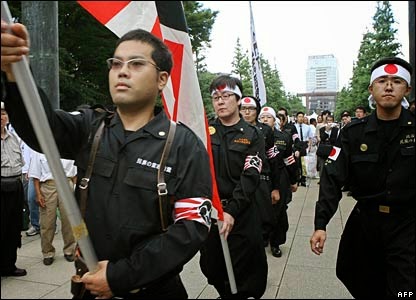 |
| Far-right activists at the Yasukuni Shrine |
In recent
weeks Net Right activists have harassed a small village in northern
Hokkaido where residents have, after years of research, uncovered the
graves of eighty Korean laborers press-ganged into constructing a
military airport in the area. The village of Sarufutsu has been
inundated by calls accusing locals of being traitors following
village efforts to build a monument in honour of the Koreans.
Far-right activists also threatened a boycott of the local shallot
industry, prompting the mayor to halt construction of the memorial. A similar backlash saw the local government in Nagasaki delay
permission for the construction of a memorial to Korean laborers
killed in the atomic bomb blast. Mainstream historians estimate that
some 700,000 Koreans were press-ganged into service by the Imperial
military, yet the far-right denies these claims, stating that the
Koreans voluntarily aided Japan.
These
actions of the far-right have been legitimized because the Abe
government has also embraced a similar revisionist stance. Despite
recent efforts to improve relations with China, Abe still continues
the tradition of visiting the Yasukuni Shrine which houses Japan’s
war dead, including war criminals. This year Abe sent an offering but
did not attend in person; however, almost two hundred other officials
attended in person. This yearly visit has led to an annual condemnation from China and South Korea, repeatedly damaging
relations. Alongside the issue of Korean workers, the plight of
former Korean (and other nationalities) sex-slaves, euphemistically
called ‘comfort-women’ has been a serious issue in Japanese-Korean
relations. Many thousands of women from occupied territories were
forced into prostitution by the Japanese army during WWII. No
official apology has ever been issued by Japan. In 2007, during Abe’s
first prime-ministership, he stated that there was no evidence that these women were coerced to work for the military.
Since
2012, the Abe government has made further steps to revise Japanese
history. Recently the government removed a document from 1995 posted
on the government website which called for compensation for former
comfort women. Moreover, two months ago the government was given an
unfortunate boost after the Japanese newspaper of record, Asahi Shimbun, issued a front page retraction of its series of articles
about comfort women. An investigation into the sole source behind the
stories – a soldier who claimed to have been involved in capturing
said women – found his claims to be fabricated. This scandal
greatly aided the revisionist position, whose proponents, including
the government now hold aloft this incident as proof of comfort women
related falsehoods. In the aftermath of this scandal, the
Japanese government asked the UN to partially rescind a 1996 report on comfort women. The author refused citing the testimonies of
hundreds of women, and the fact that she had not consulted the now
discredited Asahi Shimbun source.
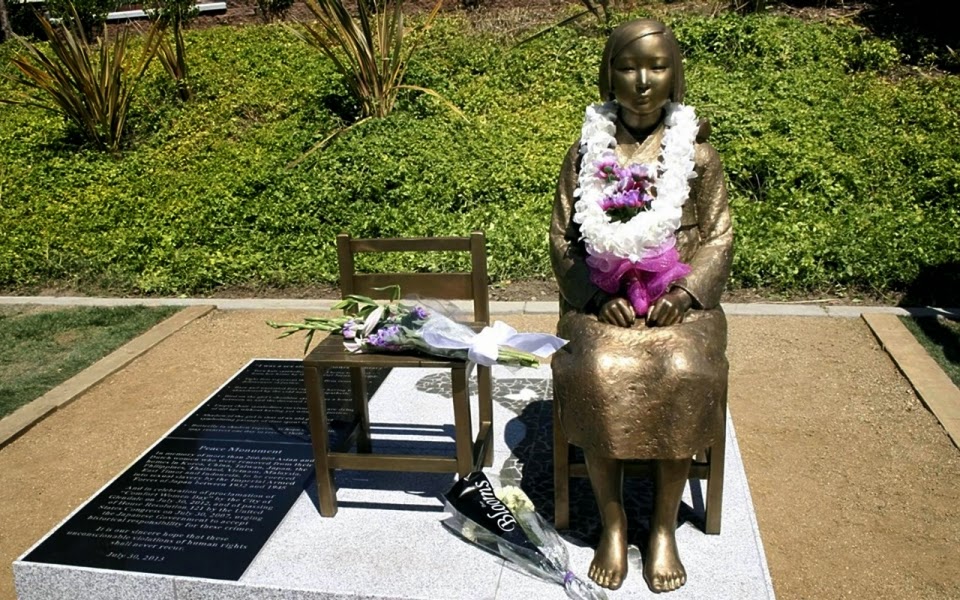 |
| Comfot Women Memorial, Glendale California Image Credit: Tetsuya Mizuno (AP) |
While
the Asahi Shimbun scandal benefited the government, the fact that the
story was printed at all irks the regime. The government has been
attempting to alter the way the media talks about the country’s
wartime legacy. Abe has filled the oversight committee of the Japan
Broadcasting Corporation (NHK) with like-minded individuals. An
internal NHK memo shows that the corporation has been instructed not
to use the words ‘coerce’, ‘sex slaves’ or ‘prostitutes’ when talking
about comfort women. Moreover, the government has for a long time
been pushing for the Nanjing Massacre (which saw the imperial army
kill 50,000-300,000 people in 1937) to be referred to as the ‘Nanjing
Incident.’
This
lingering issue is one of the chief impediments to Japanese-Korean
accord, and is part of a larger Japanese refusal to officially
apologize for its wartime activities in Asia. The cool state of
bilateral relations is apparent in the fact that both Abe and his Korean counterpart Park Geun-hye have been office since 2012, but have yet to meet. In response to the Japanese government’s
actions, Noh Kwang-il, spokesperson for the South Korean Foreign
Ministry stated that; “however hard the Japanese government tries
to distort the true nature of the comfort women issue and play down
or hide past wrongdoings, it will never be able to whitewash history.”
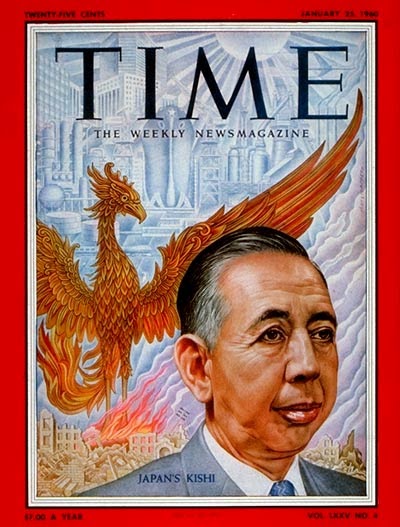 |
|
| Kishi as Prime Minister: Jan. 25th 1960 Image Credit: Time |
Abe’s
efforts to ‘whitewash’ Japan’s wartime history is not a new phenomenon, yet the prominence of such efforts within government
policy is a new development. It is important to note that many
Japanese are fully aware of their country’s misdeeds, and notable
Japanese academics have called for official apologies. The key to
understanding the government’s position on WWII is the fact that
following the war, the United States took a very pragmatic stance
vis-à-vis Japan. The U.S. did not abolish the monarchy, even
retaining Hirohito has Emperor. Furthermore many wartime bureaucrats
were pardoned in order to quickly rebuild Japan as an anti-communist
bulwark. Interestingly, Abe’s grandfather was Nobusuke Kishi, a
class A war crimes suspect who has briefly detained, but later
released, in large part due to his anti-communist sentiments. Kishi
later served as prime minister from 1957-1960.
American
pragmatism in dealing with the Imperial regime was mirrored by an
independent Japan post-1952 in which development and reconstruction
were prioritized over societal introspection. The Japanese legacy in
WWII is split into two parts, that of Japan’s fight against the
Americans, and Japan’s campaigns on the Asian mainland, where some
twenty million people died. The latter was fought out of sight of the
Japanese populace, complicated by the fact that Japan’s actions in
(primarily) China have become a vehicle for political maneuvering,
with Beijing playing the history card to discredit Japan. Over the
years Japan has become tired of being asked to apologize by China,
which due to its own human rights violations forfeits any moral
high-ground in the eyes of the Japanese. Consequently the legitimate
need for redress is buried and discredited by contemporary political
machinations.
Conversely
Japan’s war with the United States dominates the public
consciousness, because only the U.S. managed to defeat Japan: China
may have eventually ousted Japan from the mainland, but could not
have forced Japan to unconditional surrender. Japan remains the only
nation to have been attacked by nuclear weapons, and it is this
legacy that dominates the Japanese psyche. Japan is tired of being
portrayed as the sole purveyor of evil in the war. Pearl Harbor is
defining moment in American history and justification for all
subsequent actions against Japan. The death toll from Pearl Harbor
was (only) some 2400 people, almost all military personnel.
Japan
lost between 124,000-246,000 (overwhelmingly civilians) people in the
two atomic bomb attacks alone; more than the U.S. lost in the whole Pacific war (approx. 111,000). Victor’s justice sees these attacks written
off as necessity and Japan’s actions as war crimes, something which
Japan strongly disagrees with. The emphasis on its war with America,
and de-emphasis on actions in Asia has led to Japan conflating its
sense of victim-hood vis-à-vis the Americans and its memories of
empire in Asia. This has resulted in an across-the-board resistance
to accusations of Japanese war crimes by powerful countries which
themselves do not adequately address their own actions.
Originally written for Sharnoff’s Global Views
For further reading see The Role of Historiography in Sino-Japanese Relations: The Nanjing Massacre