

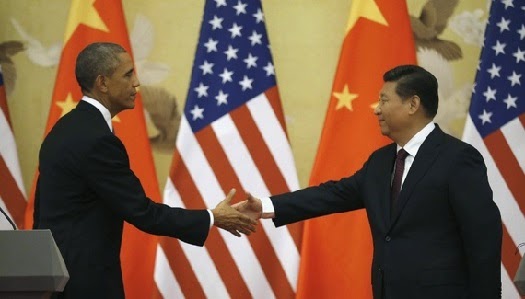
An important step in
countering global climate change was reached this week as China and
the United States agreed to cooperate on reducing emissions. Beijing
and Washington are the two largest polluters, which magnifies the
importance of the aforementioned deal. Previous efforts to cut
emissions have been stymied by alternating Chinese or American
intransigence, yet this latest bilateral pact appears promising.
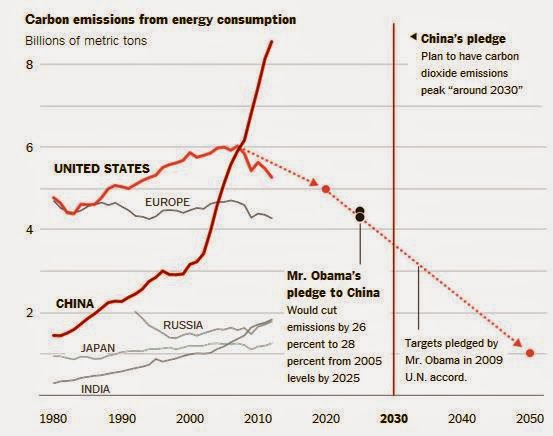
Specifically, China has pledged to see its emissions
peak around 2030, thereafter declining, as well
as committing itself to generating twenty percent of its energy from
renewable sources. The United States promised to reduce emissions
between twenty-six
and twenty-eight percent from 2005 levels by 2025.
The scale of these
promises has caused many to both laud and critique the deal, with
proponents stressing the progressive scope of these bilateral commitments, and
skeptics arguing that either more can be done, or that the stated goals
are not enforceable. Li
Shuo, a researcher for Greenpeace East Asia
voiced his approval of the plan, yet called on both countries to do
more, stating that the China-U.S. deal “should be the floor on
which [both countries] work, rather than a ceiling.” Furthermore,
while both Xi Jinping and President Obama have praised the deal,
local politicians in both countries have raised concerns.
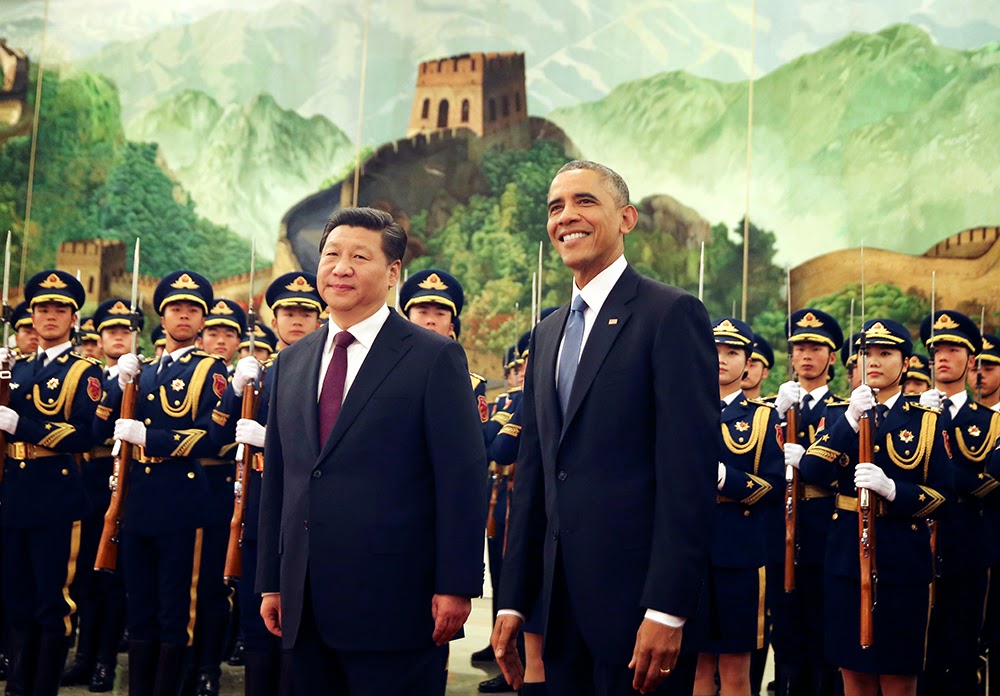 |
| Xi Jinping & Obama in Beijing Image Credit: wired.com |
In America, the newly
emboldened Republican opposition is concerned over the perceived
untrustworthy nature of Chinese government. Republicans argue that
Beijing cannot be trusted to fulfill its half of the bargain, and
that American efforts to reduce emissions would merely hurt the
economy. This view is not entirely unjustified, as recently the
Chinese government blocked
U.S. embassy Beijing air pollution data from popular websites and
apps used by many Chinese in the polluted
metropolis. The exclusion of American data forces the populace to
rely solely on official Chinese data, seen as less accurate
and often displaying lower pollution levels. This data blockage coincided
with the signing of the emissions deal, and can be seen as part of
China’s efforts to showcase Beijing in a good light whenever the
international spotlight is focused on the national capital.
Republicans are also
concerned about the impact of the deal on the U.S. economy. House
Speaker John Boehner characterized the China-U.S. emissions deal
as “jobs
crushing”. Similarly, incoming Senate
Majority leader Mitch McConnell expressed doubts over the
pact. McConnell represents Kentucky, a coal rich state, and
successfully campaigned for re-election as an opponent of Obama’s
supposed “war
on coal”. Moreover, Senator Jim Inhofe, the
incoming chairman of the Senate committee on the environment and
public works is a
professed climate change denier. Inhofe has
also stated that “it’s hollow and unbelievable for China to claim
it will shift twenty percent of its energy to non-fossil fuels by
2030.”
It is interesting to
note that while American politicians view GDP growth and jobs as
inexorably linked, recently Chinese
Premier Li Keqiang stated that “China cares
more about jobs and livelihoods than the GDP target.” While the
reality in China is more complex than this, this statement remains
important because it disconnects notions of well-being from economic
growth. While hundreds of millions of Chinese have been lifted out of
poverty by Beijing’s economic policies, there is growing
dissatisfaction over pollution related issues. The Chinese government
is highly pragmatic and intent on maintaining stability; citizen
unrest due to pollution is taken seriously by Beijing.
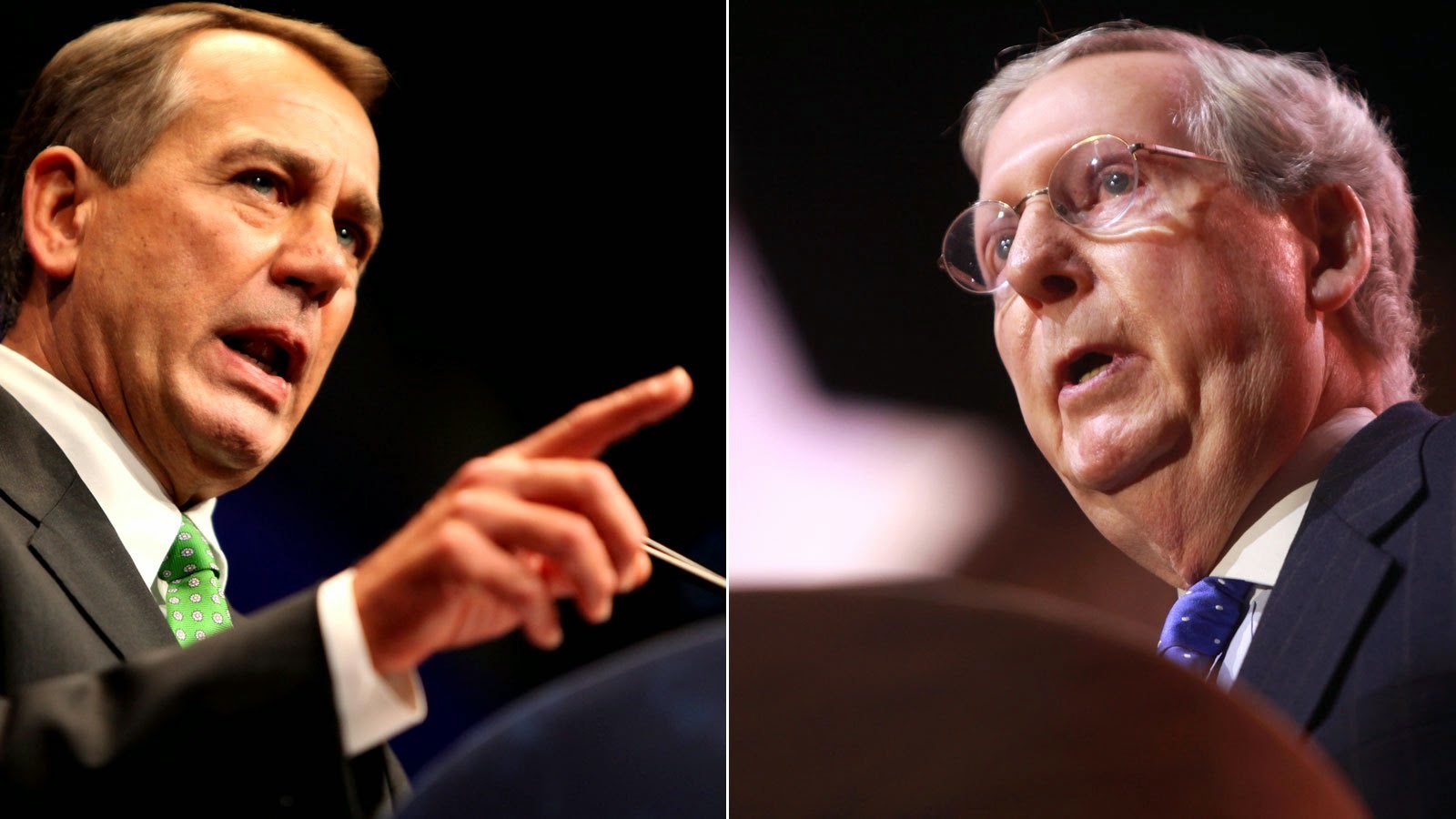 |
| Congressional Leaders: John Boehner (left) and Mitch McConnell Image Credit: grist.org |
In China many regional
and provincial leaders are also worried that the emphasis on the
environment will impact GDP growth. Given the single party nature of
the Chinese system and the stated acknowledgment by the central
government of the problem of pollution, Chinese politicians do
not espouse anti-climate change views. In China the concern amongst
Chinese officials is due to the fact that efforts to reduce emissions
slow down GDP growth. This is particularly important because the
promotion prospects of regional and provincial officials are highly
tied to meeting GDP growth figures. While
Beijing may want to lessen emissions it still overwhelmingly grades
officials on economic matters: local bureaucrats are caught in the
middle.
While China hawks like
Sen. Inhofe put little stock in Chinese promises, it is important to
note the actions which Beijing is taking to counter pollution. In
2013 China generated
9.8% of its energy through renewable means,
with non-fossil fuel energy production slated for 15% by 2020.
Moreover Shandong province is adding
air quality as a criterion to the evaluation
process of local officials. Similarly Gansu province is reassessing
its evaluation process to focus less on economic expansion. The
central government is keenly aware of the costs associated with
unchecked growth. Since 2004 China has funded the Green
GDP project which tracks the impact of
environmental damage on national growth. A 2006 report showed that
338,000 premature deaths across 600 cities were attributable to pollution.
The project has tracked the environmental cost of development, which
stood at $83.51 billion in 2004 and $251.21 billion in 2010, or 3.5%
of GDP.
 |
| Image Credit: Alicia Parlapiano |
Despite the misgivings
of domestic politicians, individuals at the federal level in both
China and the United States are seeking to move closer on climate
issues. According
to Sun Zhe, head of the Centre for U.S.-China Relations at
Tsinghua University, “the bilateral relationship is mature enough
that we understand even if we don’t have political trust for another
five to ten years, we need to live and work together. That’s a new
way of thinking by Chinese leaders.” Similarily, it is important for American
leaders to realize that they cannot continue to perpetuate a
self-fulfilling prophecy in which they refuse to implement policy
because they prematurely accuse others of non-fulfillment. This
merely dissuades China of the opinion that America is a credible
partner, thereby leading Beijing to not participate in initial bilateral proposals. This in turn only retroactively validates the
aforementioned obstructionists.
Congressional
resistance to the climate deal has important repercussions because it
undermines Chinese efforts to style itself as a responsible partner
in Asia. The Chinese government certainly considers the deal
important, with Xinhua quoting Frederic Hauge, (president of Bellona
Foundation, a Norwegian think tank) claiming that “probably
this is greater than the Kyoto Protocol.” For the Chinese this
statement has a double meaning. The explicit message is that this new
deal could overshadow the oft cited Kyoto Protocol, demonstrating the
importance of dealing with China. The second message is that by
overshadowing Kyoto, China is overshadowing the accomplishments of
Japan, long an environmental advocate and touchstone for the U.S.
when Washington wishes to deal with Asia.
The
environmental front offers an opportunity for Beijing to present a
positive image of itself and increase its profile in the West. By
championing environmentalism the government can make an effort to
make itself more accountable, diffuse popular unrest, and score
points with the West without touching on human rights issues.
China-hawks in Congress claim China is not accountable, yet by
blocking environmental legislation, the same people are blocking a
means for Chinese civil society to foster accountability and citizen
participation in domestic policy. Moreover, if China is encouraged by
American actions to partake in environmental pacts, this allows
Washington – given the transnational nature of pollution – a very
rare opportunity to critique and influence Chinese domestic policy
without allegations of foreign meddling.
An abridged version of this article was written for Sharnoff’s Global Views