

In recent
years there has been a shift in Myanmar, as the regime has begun to
transition from isolated junta to one which is increasingly embracing
democracy. This shift in outlook is reflected by the creation in 2005
of a new capital Naypyidaw: 320km from the old British colonial
capital of Yangon (Rangoon). For decades prior Myanmar had been
viewed as an insular military dictatorship, akin to fellow hermit
kingdom North Korea sans nuclear weapons and eccentric dynasties. If
the country – a product of the partition of British Raj – enjoyed
any presence in the collective consciousness of the West, it was in
the form of Aung San Suu Kyi; Nobel prize winning democracy advocate
and political prisoner.
Suu Kyi
was released from house arrest in 2010, in a move which appears to
reflect a loosening of military control in the country. This shift in
Burmese politics and society has opened up the country to the West,
resulting in the removal of sanctions and normalization of relations.
Consequently the largely untapped natural resources and sizable
population of Myanmar are seen as enticing opportunities for
investment. Washington is increasingly interested in the country,
with Myanmar potentially becoming a regional ally and trading partner
of the United States. Other nations such as Japan,
South Korea and Singapore are also seeking to invest in the country.
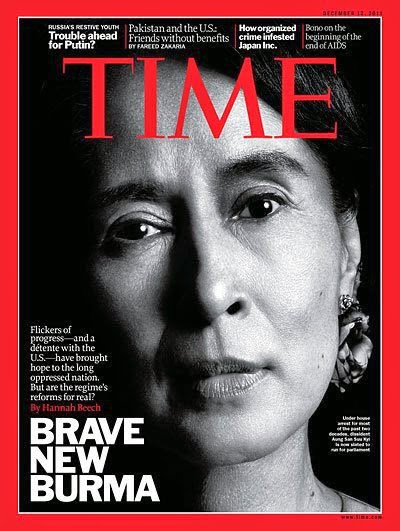 |
| Aung San Suu Kyi Image Credit: Time |
This
opening to the wider world and relaxation of junta rule has shifted
the balance of power within the country. Prior to these developments
the Burmese junta could only count China among its supporters. For
decades the Chinese government maintained a working relationship
with Myanmar, viewing the country as part of its sphere of influence.
Myanmar and China share an extensive border; with the Burmese
provinces of Kachin and Shan next to the large Chinese province of
Yunnan. Due to the isolation of the Burmese government, China enjoyed
sole access to the country, benefiting from trade in natural
resources while largely adopting a laissez-faire approach to the
Burmese socio-political situation.
Despite
this stance, Chinese traders and businesses have
for years engaged in both legal and illicit commerce with the
inhabitants of Kachin province. The Kachin ethnic group constitutes
the majority of the province’s population and has been embroiled in conflict with
the central Burmese government for over fifty years. The Kachin
Independence Organization (KIO) and its military wing, the Kachin
Independence Army (KIA) have profited from selling jade (trade in
jade alone between China and Myanmar totaled $8 billion in 2011) and
teak to Chinese buyers, thus funding their conflict with the ruling
junta.
Furthermore,
while China has long had significant infrastructure, mining and
hydrocarbon investments in Myanmar, gone are the days in which the
Burmese government rubber-stamps Beijing’s projects. The changing
times were exemplified by the decision of Burmese President Thein
Sein – following local protests (the KIO itself wants local control
over natural resources and devolved powers) – to
suspend construction of the $3.6 billion, Chinese backed Myitsone
dam.
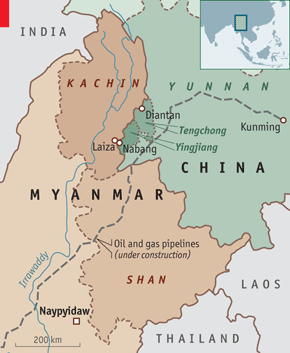 |
| Image Credit: The Economist |
Myanmar’s
opening to the West will see a diversification of foreign investment
in the country, eroding China’s monopoly. Whereas Beijing can
tolerate some American market share in Myanmar’s economy, the Chinese
government is gravely
concerned that Myanmar’s internal ethnic conflict in Kachin will
become internationalized, leading to American troops on China’s
southeastern border. China is already concerned with American
encirclement in East Asia: the thought of an American military
presence in Myanmar is utterly abhorrent for Beijing.
Myanmar’s
swift opening has caught China off guard and Beijing is rushing to
increase its engagement with Naypyidaw, fearing American encroachment
into the region. These fears were confirmed in November 2014 when
President
Obama visited Myanmar. The United States government has long had
connections with the pro-democracy movement and Aung San Suu Kyi in
particular. Beijing fears that it will lose influence as the
political winds change and its junta partners realign to remain
politically viable. Notably, Myanmar has already expressed a
willingness
to act as an arbiter for Sino-ASEAN territorial disputes in the South
China Sea; a suggestion totally counter to China’s own emphasis on
non-interference and bilateral dialogue. Third party arbitration is
also the favoured course of the United States. This confidence on the
part of Naypyidaw is indicative of a government courted by several
powers and no longer beholden to China.
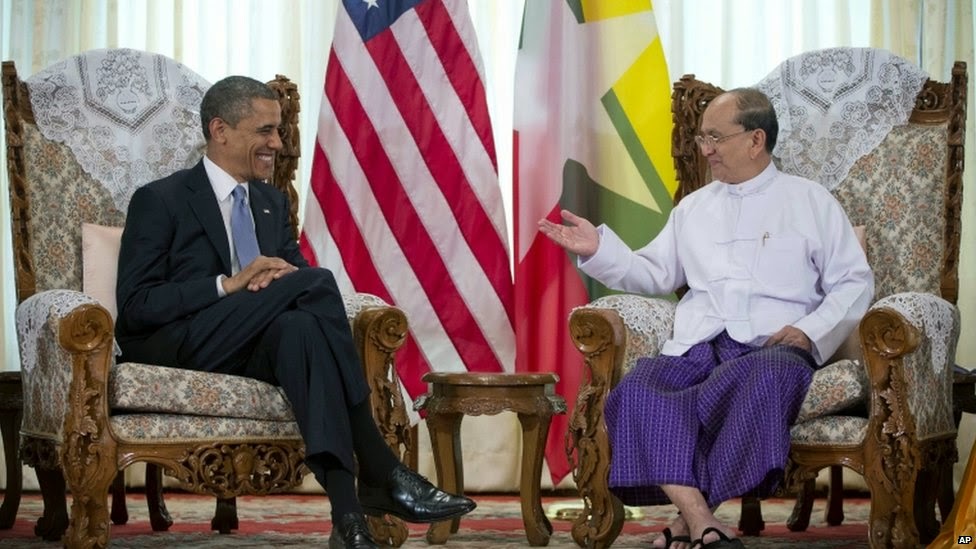 |
| President Obama meets with Burmese President Thein Sein Image Credit: BBC |
For years
Beijing has placed all its bets on the central government, while
tolerating if not prolonging the KIA’s struggle through nebulous
trading. Moreover Beijing long delegated responsibility over the
Kachin issue to provincial officials in Yunnan. This relaxed attitude
was fostered by the fact that fighting between the KIA and government
was sporadic. However in 2011 tensions flared, resulting in the
cessation
of a 17 year long ceasefire. Unfortunately for China all of its
chickens are now coming home to roost, as the rise in violence
(potential disruption of hydrocarbon flow and humanitarian crisis)
coincides with Myanmar’s opening (loss of influence in Napypidaw,
potential American inroads).
Increased
fighting between December 2012 and January 2013 saw artillery shells
land on Chinese territory and an influx of thousands of refugees.
Currently some 8000
persons inhabit the Je Yang refugee camp, right across the border
from Yunnan. These refugees engage in trade with Yunnan merchants,
relying heavily on imports from China, and utilizing Chinese
communication networks (Myanmar’s military blocks Burmese signals in
the region). Furthermore China’s minority Jingpo population on the
Yunnan-Kachin border is in all but name the same ethnic group as
Myanmar’s Kachins. Beijing naturally fears ethnic sympathies
prompting cross-border movement of KIA supporters, weapons and
conflict spillover.
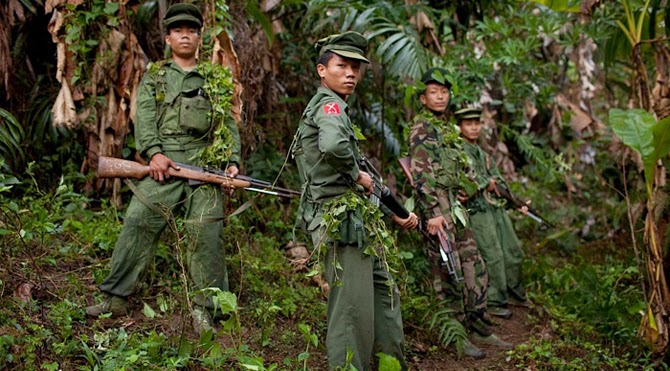 |
| KIA Fighters near the Chinese Border Image Credit: The Irrawaddy |
Qin Liwen,
former analyst for MERICS explains
China’s dilemma in Kachin, stating that:
former analyst for MERICS explains
China’s dilemma in Kachin, stating that:
“On the
one hand it’s good for China to have special connections with the
Kachin so [China has] some kind of “chess on the board [sic]”
when they talk to Myanmar central government. But if they get too
supportive the Kachin people will of course make trouble. So it’s
always a very subtle game to balance it all.”
This
longstanding trading relationship with the KIO/KIA has resulted in
several
hundred Chinese traders and workers becoming trapped by the fighting
in Kachin. In response China has increased the presence of
Chinese troops (PLA) on the border. Furthermore in 2013 Beijing
arranged a bilateral (KIA-junta) dialogue with China as the
negotiator. China has also created a new government position –
Special Envoy on Asian Affairs – headed by Wang Yingfan, to deal
with Myanmar. Following the increase in violence Beijing has also
sent Vice Foreign Minister Min Fu Ying and PLA general Qi Jianguo to
Myanmar for negotiations and security consultations. Furthermore in a
move to counter Obama’s rapprochement towards Myanmar, Chinese
Premier Li Keqiang also visited Myanmar in November 2014.
This article was originally written for Sharnoff’s Global Views