

In recent years, Myanmar has begun to open up and embark on a
laudable path towards democracy. Despite this trajectory, however,
another disturbing narrative exists which is increasingly coming to the
world’s attention. The plight of the Muslim minority Rohingya people is
one of systematic repression teetering on genocide. In 1982 a law was passed denying citizenship to the Rohingya people, who now live in camps
or cordoned off villages. Widespread hostility towards the Rohingya and
government repression of the group threatens to escalate to systematic
violence if relations deteriorate.
Widespread prejudices persist against the Rohingya, who are seen as
foreigners by the Buddhist majority. Many believe the Rohingya to be
interlopers from Bangladesh who followed British troops into Myanmar in
the 1800s. This notion legitimizes those continuing to deny the Rohingya
people citizenship and equal rights. The Rohingya are a small minority
group, yet are not recognized as one of Myanmar’s 134 ethnic groups. The
danger for these people is that continuing anti-Rohingya sentiments in
the population could lead to a genocide. There have already been instances of anti-Rohingya violence which have resulted in dozens of deaths.
Myanmar, with its Buddhist majority, comprised part of British India
bordering Muslim-majority Bangladesh. People moved fluidly within the
common imperial political structure, but the establishment of modern
borders caused many groups to be isolated from one another. Today, the
danger for the Rohingya is that their perceived status as outsiders and
parasites on Burmese society leads to similar rhetoric found in areas
ravished by genocide.
For instance, in Rwanda, Tutsis were often
labelled foreigners in the country, brought in by imperial powers and
lacking legitimate historical or social ties to Rwanda. Such rhetoric
facilitated the Rwandan genocide as Tutsis were easily portrayed as
sub-human outsiders. Similarly the mass slaughter of Muslim Bosnians at
Srebrenica in 1995 was facilitated by views of Muslims as foreign,
relics of Ottoman imperial control over the Balkans, and therefore
legitimate targets.
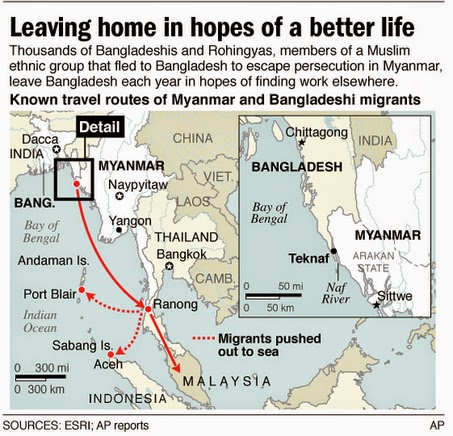
The situation in Myanmar is more akin to Bosnia than Rwanda due to
the fact that identities are constructed around ethno-religious ties.
However, the Rohingya’s plight is also unique because, despite the
ethnic pluralism in the country, the Rohingya remain non-citizens due to
Buddhists’ fears about Muslim influence on Burmese culture and society.
In this case, religious strife – already a dangerous factor – has been
linked to ethnic identities, as most Muslims in Myanmar are Rohingya.
Whereas religious identity is fluid, ethnic identity is permanent, and
herein lies the greatest threat to the Rohingya.
By conflating the two
identities Burmese Buddhists come to view the Rohingya as not only
different in degree, but also in kind. Their otherness is in turn
fundamentally tied to their very existence as people, which denies the
possibility of change or compromise, for how can one compromise elements
at the very defining core of one’s being? Historically when large
segments of society reach this conclusion about a minority, the
potential for ethnic cleansing and genocide drastically increases. The
international community is beholden to ensure such actions do not
transpire in Myanmar.
This piece was originally written for STAND Canada