
While the West and the world’s media attention
has been focused on the rise of ISIS in Iraq and Syria, China has
been gripped by a wave of violence perpetuated by homegrown Muslim
terrorists. Last week fifty people were killed (including forty
suspected assailants) and more injured as multiple explosions shook
Luntai County, Xinjiang. In the past eighteen months, over
300 people have been killed by aggressors with
links to Xinjiang, the autonomous region in western China. Xinjiang
is home to the Uighurs, a minority numbering some ten million,
scattered across China’s far western expanse and bordering several
Central Asian countries. The Uighurs are a Turko-Islamic people who
long lived on the periphery of Qing China, in an atmosphere of
semi-independence as a tributary state to Beijing. Following the fall
of imperial China in 1912, Xinjiang enjoyed de facto independence
during the mid to late 1940s as the East Turkestan Republic, before
being reincorporated into the People’s Republic of China in 1949.
 |
| Uighur Unrest tops Beijing’s Domestic Security Concerns |
The Han dominated
central government in Beijing has long viewed Xinjiang as a restive
frontier, inhabited by troublesome minorities who refuse to
assimilate and adopt the majoritarian norms promoted by the
government. This tension has increased in recent decades for several
reasons. Firstly, Central Asian nations each inhabited by Turkic
peoples which emerged on to the world stage after the collapse of the
Soviet Union, spurred similar separatist sentiments in Xinjiang. More
recently the rapid industrialization of China and corresponding need
for resources has seen large scale Han migration (actively encouraged
by Beijing) into Xinjiang, lured by construction, resource extraction
and defence related projects. This demographic pressure combined with
Beijing’s emphasis on a Han-dominated, unified national identity has
led to the increasing marginalization of the Uighurs. Unequal access
to jobs, government services as well as prejudicial sentiments within
the migrant Han population has also led to growing discontent and
radicalization.
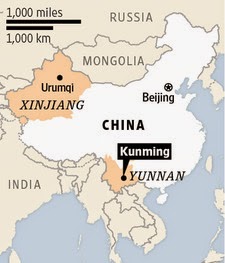 |
| Photo Credit: Wall Street Journal |
The explosions in
Luntai County are merely the latest in a recent upsurge in
Uighur/Xinjiang linked violence. In March a knife
attack in the southern city of Kunming left
twenty-nine dead and 143 injured. Two months later in May 2014,
Uighur extremists detonated explosives in and drove off-road vehicles
through a crowded market in Xinjiang’s capital Urumqi, killing
thirty-nine and injuring more than ninety. In
response the government executed thirteen individuals linked to
Xinjiang attacks in June, and on September 24th executed
eight others implicated in five separate acts, including suicide car
crashes in Tiananmen Square which killed the attackers and two
tourists.
Even moderate Uighur voices are falling victim of Beijing’s
crackdown, which has been paying extra attention to Xinjiang since
the 2009
Urumqi uprising which left hundreds dead and
injured. On September 17th the Urumqi Intermediate
People’s Court began the trial of Uighur activist Ilham Tohti, who
has been accused of separatism. Tohti is a moderate Uighur voice, who
while advocating to the Uighur cause has repeatedly sought to mend
Han-Uighur relations by campaigning
against ethnic intolerance and anti-Han sentiments
within the Uighur community. Tohti ran afoul of the central
government after creating Uighurbiz in 2006, a Chinese
language website fostering Han-Uighur understanding. Tohti has
repeatedly been subject to house arrest, and only four days after his
trial began, on September 21st was sentenced to life in
prison.
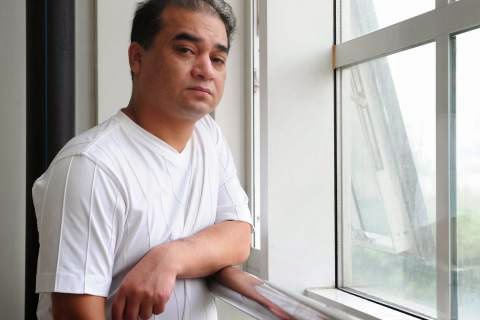 |
| Moderate Man, Harsh Sentence: Ilham Tohti Recieves Life in Prison Photo Credit: AFP |
Alongside a predictable
security crackdown in the region, Beijing has increasingly been
implementing policies which seek to undermine Uighur identity, and
which many critics characterize as efforts to “Sinify
the Uighurs.” These efforts tout the
promotion of secularism and community (read Han) values, by
delegitimizing Uighur values, often surrounding Islamic pratices. For
instance, during his incarceration, Tohti went on a ten
day hunger strike because the guards refused to
give him halal food. Such actions are in line with Beijing’s larger
goal of stamping out the Muslim identities of Uighurs. The
government has recently banned young Uighur
from growing beards or wearing Muslim garb. Similarly in April 2014,
Shayar County introduced
a program which offers rewards to people who
informed the local government about individuals under the age of 18
who are suspected of growing a beard or attending a mosque.
Recently President Xi
Jinping suggested that more
Uighurs should be moved to Han dominated areas
for education and employment. Furthermore, in recent weeks, Chinese
officials in Xinjiang have begun offering various incentives to
encourage Han-Uighur intermarriage. Cherchen County in southern
Xinjiang is offering 10,000 renminbi ($1600) a year for five years to
Han who marry one of China’s fifty-five minorities. The government is
also offering inter-married couples priority consideration for
housing and government jobs, as well as up to $3200 a year in health
benefits. Moreover the government is also promising free K-12
education for children of mixed parentage, and tuition subsidies for
technical school or university. Cherchen County director, Yasen
Nasi’er, said that inter-ethnic marriages were “an
important step in the harmonious integration and development of all
ethnicities.” Yasen went on to characterize
such marriages as positive energy contributing to the realization of
the “Chinese Dream,” a concept popularized by President Xi
Jinping.
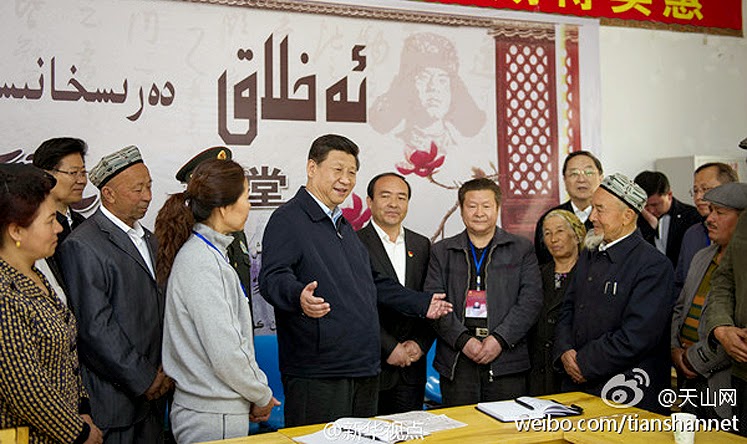 |
| The Chinese Dream: Xi Meets Uighur Community Leaders in Urumqi |
These restriction have
been put in place because the central government sees the expression
of Uighur identity as a threat. The position of Uighurs as Turkic
Muslim non-Mandarin speakers who agitate against the status quo
undermines the efforts of Beijing to mold a unified modern Chinese
identity. The government is pushing strongly to instil the image of
21st century China as Mandarin, Han and secular. These
efforts are driven by the desire to prevent another Tibet situation
in Xinjiang and other minority areas. Specifically, this means
preventing the establishment of a robust non-Han identity which
challenges the official discourse emanating from Beijing.
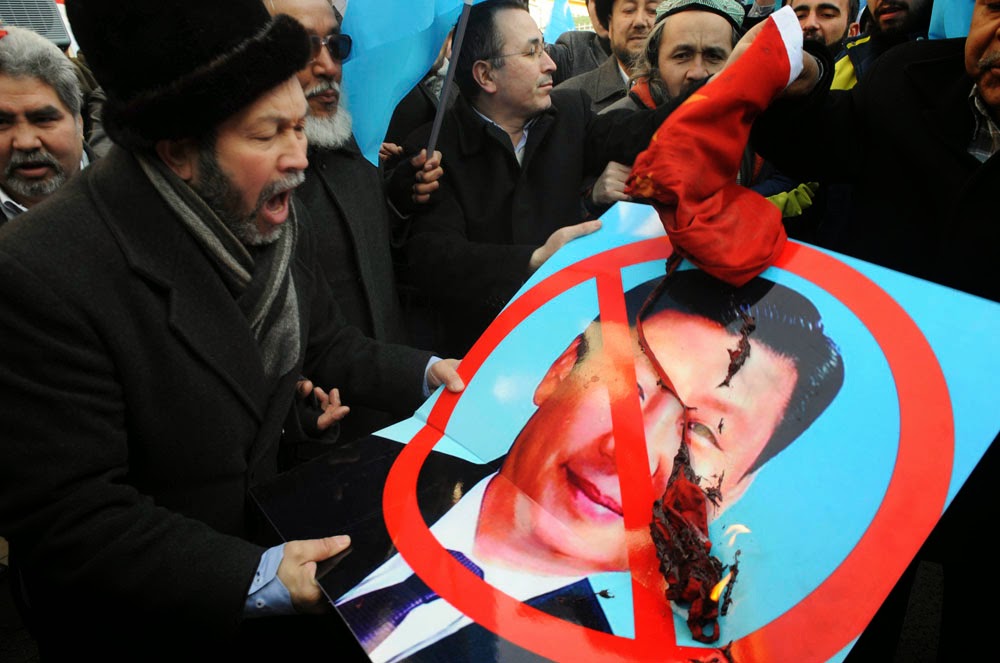 |
| Beijing Fears Spillover: Uighur protesters in Ankara, 2012 Photo Credit: Reuters |
At a
meeting discussing recent Uighur violence, Xi called on the
government to “establish correct views about the motherland and the nation”
among China’s minorities. The greatest fear for the central
government is an internationalization of the Uighur cause. The
proliferation of international sympathies for Tibetan independence
haunt the Chinese leadership. Consequently their chief priority is
preventing the situation in Xinjiang from attracting foreign
attention and creating unrest, either from the West, but more
importantly from pan-Turkic sympathizes and the greater Muslim
world.