
Berlin Conference in a rush to secure territory in Africa. The colonial
powers sought to delineate their respective claims, in what was termed
the “Scramble for Africa”. During the past several years there has
emerged a new territorial scramble; not in Africa but in the South China
Sea. Whereas the nations of Europe sought to negotiate, the States
ringing the South China Sea have exhibited a more confrontational
manner. The unresolved status of various islands, shoals, atolls, and
reefs combined with the tantalizing hints of immense hydrocarbon wealth,
alongside fisheries resources, has ignited a rush among the countries
of the region. China, Taiwan, Vietnam, Malaysia,
Brunei, Indonesia, and the Philippines are caught in a web of
overlapping territorial claims, resulting in increasing tensions in the
region. While the Sino-Japanese dispute over the Diaoyu/Senkaku islands
to the north has garnered the most media attention as of late, this
second and arguably more important series of disputes demands greater
attention. Each of the countries listed above asserts often competing
claims over various parts of the South China Sea, yet for all the chief
contender is China. Beijing has laid claim over almost the entirety of
the South China Sea, arguing that the region constitutes part of its
territorial waters.
China has laid claim to the myriad of tiny outcroppings (and surrounding
seas) that dot the region. China remains staunchly committed
to its so called Nine-Dash-Line, which encompasses a vast area, in many
cases overlapping with the existing exclusive economic zones (EEZs) of
various States. Chinese relations with the countries of the region are
multifaceted and vary from State to State. In order to gleam the key
themes in this dispute, it is useful to look at Chinese relations with
one of Beijing’s most vocal counterparts in the region – the
Philippines.
The Lands that Treaty Law Forgot
Islands are the main flashpoints between China and the Philippines. The
uncertain status of the islands in the South China Sea are due to the
fact that they managed to become no-mans-land during the first half of
the 20th century. Following the Spanish-American War of 1898,
the 1900 Washington Treaty (which amended the 1898 Paris Peace Treaty),
saw the US lay claim over the various islands of the Scarborough Shoal,
previously administered by Spain. The Philippines argues that since
these islands were administered from the colonial administration in
Manila they fell under Philippine jurisdiction following independence in
1946. Meanwhile, the Spratly Islands came
under Japanese control in the 1930s. After WWII, Japan was forced to
relinquish sovereignty over the islands in accordance with the San
Francisco Peace Treaty. The problem was that the treaty instructed Japan
to relinquish control, yet it did not specify to whom Tokyo ought to relinquish said control to. Consequently the Philippines declared the area Res nullius (no-mans-land)
and therefore open to annexation. Conversely, China views the South
China Sea as part of its territory, claiming inherited territories from
the Qing dynasty.
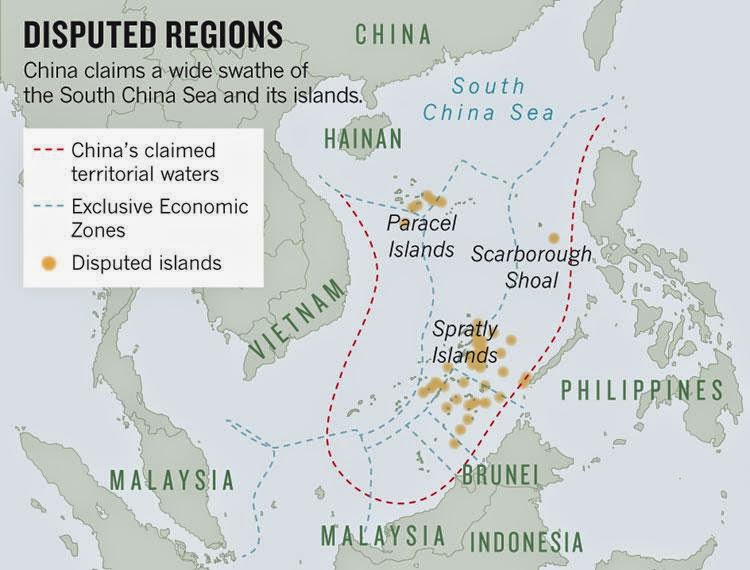 |
|
| Extent of China’s Nine-Dash-Line Photo Credit: China Daily Mail |
been existed for decades, it was in the late 2000s that tensions began
to rise and the “South China Sea Scramble” began in earnest. In 2009 the
Arroyo government included the Scarborough Shoal
(referred to as Kulumpol ng Panatag by Manila) in the Philippines
Baseline Law – legislation designed to solidify the country’s borders
and maritime claims. A similarly assertive policy has been followed by
the regime of President Benigno Aquino III, with Aquino stating that
“China’s 9-dash line over the entire South China Sea is against international laws, particularly the United Nations Convention of the Law of the Sea,” in 2011. China’s disagrees, as elucidated by Wu
Shicun, President of the National Institute for South China Sea Studies
on January 15, 2014. Wu stated
that “China’s claim – defined by the South China Sea “nine-dash line” –
was established long before the United Nations Convention on the Law of
the Sea took effect. In accordance with the inter-temporal law, the
nine-dash line should be recognized by the international community.”
Mutual Posturing
Chinese and Philippine naval forces were involved in a tense standoff,
precipitated by the detainment of eight Chinese fishing vessels by the
Philippine Navy near the Scarborough Shoal. Both countries’ naval
vessels in turn jostled over control of the fishermen and their fishing
boats. In the end the Philippine navy was forced to back down. This
confrontation resulted in China retaining de facto control over the shoal since 2012, as demonstrated by the erection of a barrier to the shoal’s entrance in July 2012. In addition, Aquino renamed the section of the South China Sea falling within the 370km EEZ as the West Philippine Sea in 2013 in order to assert Philippine claims to the resource-rich territories, a move which encompassed the Scarborough Shoal and parts of the Scarborough
Shoal is highly important for the Philippines because while the shoal
only consists of 120 square kilometres of land, the shoal’s EEZ is
494,000 square kilometers – thirty-eight percent of the Philippine’s total EEZ coverage.
| Tiny Outcroppings Threaten Massive EEZs – Chinese claimed rock in the Scarborough Shoal Photo Credit: bittooth.blogspot.com |
posturing and rhetoric, with both countries accusing the other of grave
infringements of national sovereignty and international law. The Chinese
have sent their new aircraft carrier to the region while boasting of
the increasing amphibious capabilities of the People’s Liberation Army
Navy (PLAN). China also conducts regular patrols in the contested
waters, with officers and sailors conducting on-board ceremonies, undertaking oaths to protect national sovereignty
at various disputed shoals in the South China Sea. Moreover Chinese
ships were cited in James Shoal (about 80km from the Borneo coast) on
the January 31st. In response the Philippines has sought to bolster its defence spending, with the military stating on January 15th that it is seeking to acquire six frigates to secure the West Philippine Sea.
This comes on the heels of Manila purchasing two refurbished vessels as well as a $40 million military assistance package from the United States. Similarly, on January 17th it was reported that the Philippines is also building two air force facilities in order to upgrade maritime defence over the West Philippine Sea. Manila’s efforts towards military
modernization and expansion are in response to increasing Chinese
assertiveness, fuelled by Beijing’s uptick in military spending as well
as its growing confidence on the international stage. Chinese
comportment towards the Philippines and the ASEAN region in general
vacillates between conciliatory overtones and assurances of its
continuing commitment to regional peace and stability, and brash
unilateral pronouncements and gunboat diplomacy.
foreign policy in the post-Mao era has long been characterized by
pragmatism and realist geopolitical considerations. Consequently,
despite appearances, it seems that Beijing sincerely wishes to maintain
peace and stability in the region. China does not want to overly
antagonize the United States and its regional allies which would draw
Washington’s gaze and ire further towards East Asia. Nor does Beijing
want to undermine its own efforts to cultivate soft power in the region
by alienating ASEAN Members States, as this would hinder its overarching
aim, namely to balance the American “Pivot to Asia”.