
The conquest of large
swathes of territory in Iraq and Syria by ISIS has seen the group
become a household name, as the international community organizes to
counter the terrorist group. ISIS has attracted thousands of Iraqis
and Syrians, as well as foreign jihadis, to its cause. The group has
garnered international sympathy from radical Islamists, with
governments fearing the emergence of a global terrorist network which
utterly dwarfs Al-Qaeda’s power and reach circa 2001. Many fear the
rise of satellite groups aligned with ISIS in various hotspots around
the globe. Such concerns would initially appear to be justified in
part by the recent declaration of allegiance by Philippine terrorist
group Abu Sayyaf to ISIS.
The Philippine group is
a radical Islamist group which has been active since the early 1990s,
based in the southern province of Basilan and Sulu. The group’s
ultimate aim is the secession of these regions from the Philippines and
the creations of an Islamic theocracy. Abu Sayyaf is one of the
smaller terrorist groups in the southern Philippines – estimates as
to the group’s size range from some three hundred individuals to
under a hundred. Until recently Abu Sayyaf along with the larger and
better known Moro Islamic Liberation Front (MILF) were fighting the
Philippine government, yet on January 25th 2014 both sides
agreed to a peace deal. This deal will see the creation of a Muslim autonomous region (Bangsamoro) in the southern
Philippines in return for the disarming of MILF, reduction of local
militias, removal of heavy government troop presence and creation of
common police force.
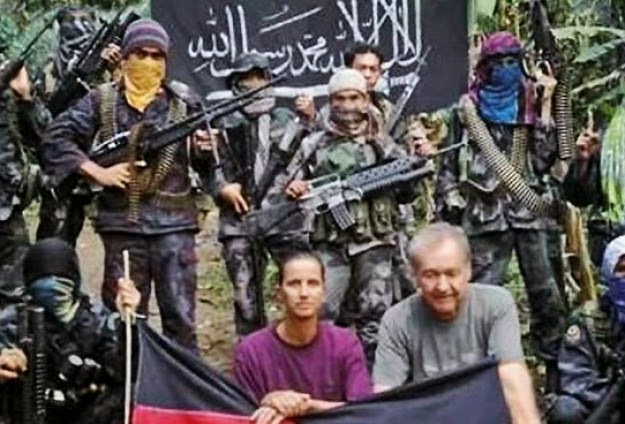 |
| Abu Sayyaf Fighter Display German Hostages |
This peace deal was
opposed by the more radical Abu Sayyaf, which did not attend the
peace negotiations, nor ceased their campaign of violence. During the
summer the group raided a Malaysian fish farm and ambushed civilians
celebrating Eid Al-Fitr in late July. The group also claims
responsibility for the 2004 SuperFerry 14 bombing which killed 116 people. Last week’s
announcement of ISIS allegiance came in a video which also included a
ransom demand for two German tourists. Abu Sayyaf has demanded a
ransom of $5.6 million as well as the end of Germany’s support for the
American led campaign against ISIS in Syria and Iraq. Germany’s
foreign ministry spokesperson refused to concede to these demands,
stating that such acts were “not an appropriate way to influence [Germany’s] policy in Syria and Iraq.” Hostage taking is a common tactic employed by Abu Sayyaf
which over the years has been involved in the prominent kidnappings
of around 100 people; some of whom have been beheaded.
 |
| MILF negotiator Mohagher Iqbal (left) and government negotiator Marvic Leonen (right) signing peace deal in Manila Photo Credit: www.apdforum.com |
In response to this
latest act by Abu Sayyaf, the Philippine government has firmly denied
that ISIS is operating by proxy in the country. Speaking for the
government, Lt. Col. Roman Zagala acknowledged that there are
certainly ISIS sympathizers within the group, yet there
exists no concrete connection between the two groups. In contrast
to ISIS’s unity of vision and ideological commitment, Abu Sayyaf has
in recent years become more of a for-profit criminal organization
than an ideologically Islamic group. Terrorism expert Joseph Franco
has described Abu Sayyaf’s pledge to join ISIS as “a publicity stunt. [Abu Sayyaf] is known for its clever use of media and propaganda. Latching unto the ISIS brand is an attempt to prop up its flagging reputation.”
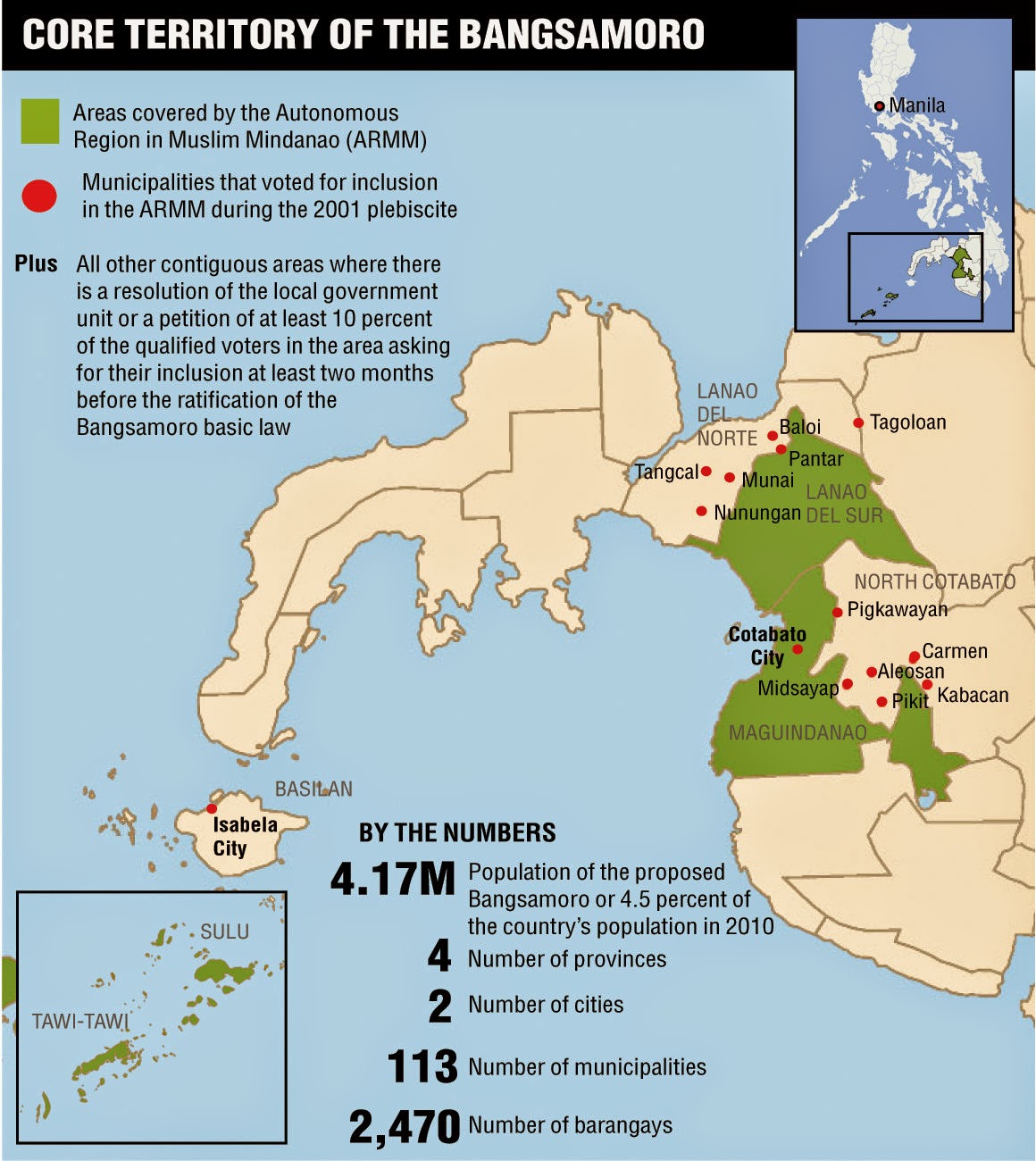 |
| Photo Credit: newinfo.inquirer.net |
With the conclusion of the
aforementioned peace deal, continuing to fight risks a loss of
legitimacy, and Abu Sayyaf is seen by many as a withering
organization. The diminished status of Abu Sayyaf is driven home by
the de-escalation of American anti-terrorism efforts in the country.
Since 1992 the United States has stationed 500 commandos in the
Philippines to aid the government in its fight against Muslim
separatists. Despite Abu Sayyaf’s posturing, Washington announced in
July that it is disbanding the Joint Special Operations Task Force Philippines.
The frivolous
connotations of the term ‘publicity stunt’ seems at first
anachronistic when associated with terrorists, yet it is a very
important point. Many people are misled by the ‘-ism’ in ‘terrorism’
into viewing it akin to other -isms i.e. ideologies. Terrorism is a
tactic and many groups have used it for a myriad of reasons. These
disparate groups have also been keenly aware of branding. The same
phenomenon behind disparate groups rallying behind the ISIS banner
was behind groups claiming allegiance to Al-Qaeda in the 1990s and
2000s. The ISIS brand is the latest viral sensation sweeping our
interconnected world, fully embodying its dual meanings: murderous
and memetic.